Protestant Parishes of Essex
Meeting Houses
Protestantism in Essex predates the 1689 Act of Toleration that established religious freedom throughout England, except that it excluded Catholics and Unitarians. Before the Act of Toleration, Protestants worshiped in homes, among friends, or in secret. Nonconformist clergy would, at times, use Anglican pulpits. After the Act of Toleration, Protestants undertook the registration and construction of thousands of Meeting Houses, an infrastructure campaign that continued throughout the 18th century. Quakers were an exception, building Meeting Houses before 1689, despite prohibitions and persecutions. In the 20th century, many Protestant Meeting Houses were lost to World War II, neglect, and redevelopment.
Analysis of Michael Watts
The reduction in the number of Meeting Houses belies the magnitude of Protestantism during the 18th century. Current scholarship and most available sources on the history of Protestants discuss theological themes. Few reports quantify the size of the movement before 1800. Two important sources, however, are The Dissenters by Michael Watts and Evan’s List. The Dissenters was published in three volumes, the first coming out in 1978. [cm_simple_footnote id=1] Evan’s List is a set of notes that a clergyman kept during the early 1700s for a book on nonconformity that he never published.
Michael Watts estimates that Essex in the early 1700s had at least 76 nonconforming congregations, with a combined membership of 18,680. Most would agree that his estimates understate the number of nonconformists because it includes the bold and socially active nonconformists, while not counting those who had nonconformist sentiments but who were afraid to voice their beliefs publicly. The 1851 census of religion in Essex demonstrates the undercount could be large. The 1851 census, completed during a period of increasing tolerance, showed that 30% of Essex was nonconformist. According to Michael Watts, Quakers were the largest group of nonconformists in Essex between 1700 and 1730, followed by Presbyterians and Independents.
Evans List
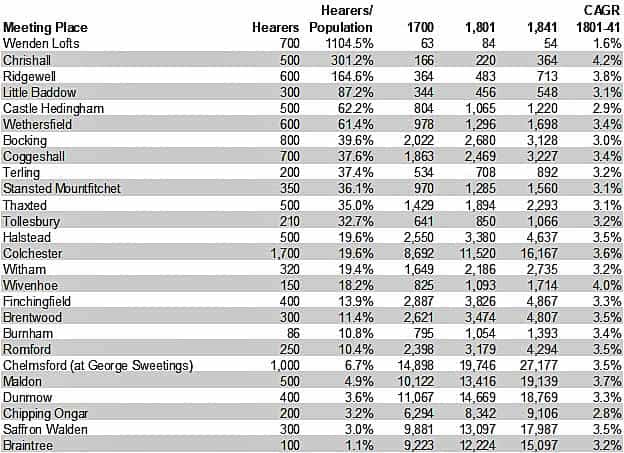
If measured by population, Colchester and Chelmsford, with 1,700 and 1,000 congregants respectively, were the major centers of nonconformity in Essex during the early 1700s. If measured by intensity, that is, the percentage of the population in a particular town or village that was nonconformist, the top ten centers of nonconformity in Essex during the early 1700s were Wenden Lofts, Chrishall, Ridgewill, Little Baddow, Castle Hedingham, Wethersfield, Bocking Coggeshall, Terling and Stansted Mountifichet.
The hamlet of Wenden Lofts is instructive. Its population in 1700 was 63 inhabitants, but its congregation totaled 700. While the ministry of Wenden Lofts might have included more than one Meeting House, we can still conclude that the entire area was solidly nonconformist.
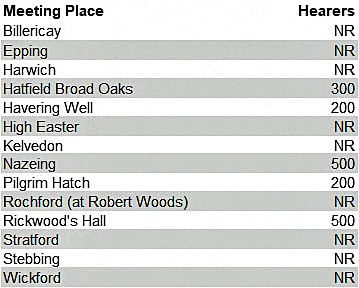
Several locations on Evans List are hard to evaluate, either because the list does not record the number of Hearers or because the size of the population is unknowable.
For example, the tiny hamlet of Pilgrim Hatch on the outskirts of Brentwood had 200 nonconformists regularly attending meetings, which must have been much larger than the number of its inhabitants. The intensity of nonconformity in Pilgrim Hatch seems to have matched that of Wenden Lofts. Billericay is problematic because it is a town, a parish, and a district. Despite missing data, we can cautiously conclude that the locations on Evans List with a headcount but whose populations size is unknown must have been additional strongholds of Protestantism.
Baptist Parishes
In 1612 the first Baptist congregation of England was organized by Thomas Helwys at Spitalsfield, now part of London. The inaugural Baptist church in Essex was the Colchester Baptist Church, which was established in 1630. In 1642 the Particular Baptist Church was organized in London, which was a branch of Baptists that emphasized the Calvinist idea of predestination. Baptist congregations were scatter throughout Essex. Burnham-on-Crouch had a pre-1700 congregation attended by members of the Wood family. Its register of baptisms begins in 1686. Tillingham had a Baptist Congregation and Southminster had nonconformist congregations that persons with the Wood surname attended. Harlow has a Baptist congregation that dates to 1692. “A General Baptist church, embracing Pilgrims Hatch, Hornchurch, and Upminster, existed before 1700.” [cm_simple_footnote id=2] Thomas Wilson, the local historian of Upminster reports that the Wood family of Upmister was Baptist and came to Upminster from Billericay, where the family had lived for generations.[cm_simple_footnote id=3]
The Baptists were early advocates of religious freedom and human rights. A famous Baptist preacher was Charles Spurgeon (1834-1892), who was born in Keveldon, Essex. He joined the Newton Baptist Church in Colchester when he was fifteen years old. His preaching attracted large crowds and won many converts. The Angus Libriary and Archive, housed at Regent’s Park College, claims to be the “leading collection of Baptist history and heritage worldwide.”[cm_simple_footnote id=4] Another excellent source of is the Baptist Historical Society of England and Wales.[cm_simple_footnote id=5]
Quaker Parishes
The Quakers began in the 1650s in northwest England. James Parnell introduced Essex to Quakerism in 1655. James preached Halstead, Stebbing, Felstead, Coggeshall, and Witham. James, only eighteen years old, was imprisoned at Colchester Castle, where he died in April 1856. In the same year, Quakers began public worship in Chelmsford. Before he died in prison, James Parnell converted to Quakerism George Fox, a fellow inmate. George Fox is often considered the founder of the Quakers in England because he travelled tirelessly, bringing structure and stability to the movement. In 1667 Fox established monthly meetings in Heybridge, Steeple, Cressing, Witham, Baddow, and Fuller Street. In the early 1700s, the administrative center of Quakerism in Essex was moved to Chelmsford, Brentwood, Billericay, and the outlier of Maldon.[cm_simple_footnote id=6]
Independent Parishes
Independents are also known as Congregationalists. The Independents wanted autonomy over their own worship. Three famous Independent Meeting Houses in Essex are the Independent Chapel of Bocking (1707), the Independent Church of Coggeshall (1672), and Newland Street Independent Church, Witham (1715). In 1696 and Congregational Meeting House of Maldon was built at the top of Market Hill with a seating capacity of 400. Congregationalists of Billericay left for America in 1620 on the Mayflower. The Independent congregation of Billericay was formally organized in 1672.
The main concern of Independents was the transparency and democracy of church government, while still embracing the core values of Calvinism and Puritanism. In 1636 a lecturer named Grimes preached at Brentwood against Idolatry, which was a criticism aimed at the Church of England. Soon after, Phillip Sanders, the once Assistant Curate of Hutton, was suspended for nonconformity. [cm_simple_footnote id=6] John Owen (1616-1683) was a seminal theologian of the Independent movement, becoming their leading spokesman. In 1646, he was appointed the vicar of Peter ad Vincula, which is in Coggeshall. He was the chaplain to Oliver Cromwell, and the Chancellor of Oxford University. Even today he is considered a relevant and articulate theologian.
The 1662 Act of Uniformity ejected two thousand ministers from the Church of England. Many of these priests were Independents as they objected to how the Anglican church exercised its authority. Following the Act of Uniformity, ejected clergy were often licensed as Independent ministers (and sometimes as Presbyterian ministers). [cm_simple_footnote id=7] The following list is not exhaustive:
South Weald: William Rathband, 1662, Vicar of South Weald.
Little Warley: William Powell, 1662, minister of Brentwood Chapel.
Little Baddow: Thomas Gilson, 1669, began preaching at the Conventicle of Brentwood.
Ingatestone: John Willis, 1669, began preaching at the Conventicle of Brentwood.
Cranham: John Yardley, 1672, ejected Vicar of Cranham began preaching in Brentwood.
In 1690 there was a short-lived union between Independents and Presbyterians which established a common fund to pay clergy, but the fund was dissolved over doctrinal differences.[cm_simple_footnote id=8]
Presbyterian Parishes
Like Independents, Presbyterians wanted local autonomy but instead of autonomous administration, they wanted autonomy over what the local minster preached. The Reverend George Whitefield (1714-1770) was an effective orator who helped to shape Presbyterianism in England and the American Colonies.
The oldest, or at least one of the oldest, Presbyterian churches dates to 1653 at Epping Upland, Essex.[cm_simple_footnote id=9] The 1672 Declaration of Indulgence pushed a second wave of clergy out of the Church of England. This clergy did not quarrel with the administrative authority of the Anglican church but rather held beliefs that tittered on the ill-defined edges of Anglican orthodoxy. The Test Act of 1672 imposed civil disabilities on Catholics and Nonconformists for failing to take communion in the Church of England. These acts provided the Presbyterian movement, and to a lesser extent the Independent movement, with a pool of unemployed clergy. Many clergymen forced out of the Church of England, were licensed as Presbyterian teachers or ministers. The following list is instructive but not exhaustive.
Ilford and Barking: In 1672 Edward Kighley was licensed as a Prebyterian minster to preach as his own house at Aldborough Hatch (Ilford), followed by William Taylor in 1676 who had a Presyberitan conventicle at his house in Barking.[cm_simple_footnote id=10]
Walthamstow: A Presbyterian meeting was licensed in Walthamstow in 1672 [cm_simple_footnote id=11]
Wivehoe: John Argor who lost his pulpit in Braintree, was licensed as a Presbyterian teacher in 1672 at Wivenhoe [cm_simple_footnote id=12]
Colchester: Owen Stockton, who lost his position as a clergyman, was licensed as an Independent teach in 1672 at Colchester.[cm_simple_footnote id=13]
Great Warley: “The house of Charles Halt was licensed for Presbyterian worship in 1672.” At Great Warley [cm_simple_footnote id=14]
Romford: In 1672 Samuel Deakin was licensed to conduct worship in the house of George Locksmith there, and William Blackmore to do so in his own house at Hare Street; at the same time the houses of William Mascall, surgeon, and William Wood, both at Romford, were also licensed for Presbyterians.[cm_simple_footnote id=15] [footnote]